
A diesel truck that suddenly stalls on the highway or refuses to start at a delivery stop puts more than a schedule at risk. It puts the driver in a potentially dangerous roadside position with limited time to make the right decisions.
Dead batteries, lockouts and unexpected fuel shortages are among the most common reasons commercial drivers call for emergency truck assistance – and all three can often be resolved without towing. But how you respond in the first few minutes matters. This guide covers the immediate steps to take after a breakdown, how to recognize common diesel truck problems, and when to call for professional diesel truck roadside assistance in Indianapolis and the surrounding area.
1. What Should You Do Immediately When Your Diesel Truck Breaks Down?
The priority is always safety – yours and everyone else on the road. Before you assess the problem or make any calls, take these steps in order.
Move Your Truck to a Safe Location
If the truck can still be controlled, guide it off the travel lane as quickly and safely as possible. A highway shoulder, rest area or designated emergency pull-off is preferable to stopping in traffic. Avoid stopping on curves, near intersections or anywhere visibility is limited.
If the truck loses power suddenly and cannot be safely moved, stay in the vehicle with your seatbelt on and activate your hazard lights immediately. Do not attempt to push or steer the truck on foot in an active traffic lane.
Activate Hazard Lights and Make the Truck Visible
Hazard warning lights go on the moment you recognize a problem – not after you’ve stopped. Under Indiana’s Move Over or Slow Down law, approaching motorists are required to move over or reduce their speed when passing a disabled vehicle with flashing hazard lights. Making your truck visible gives other drivers the time they need to react.
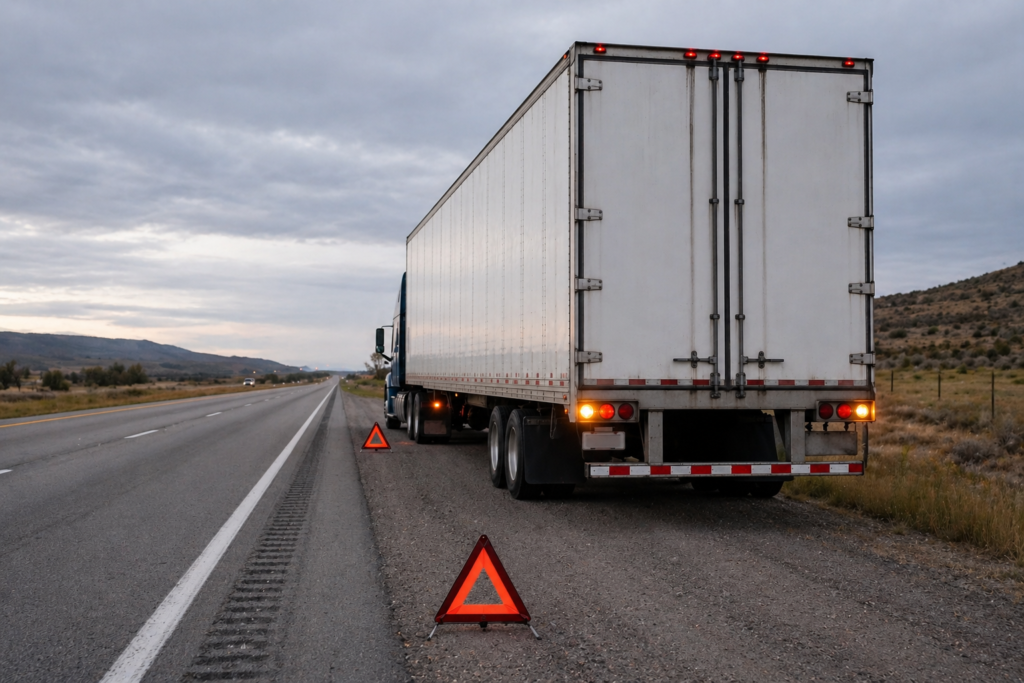
For commercial motor vehicles, federal FMCSA requirements specify the use of emergency warning devices – including reflective triangles – to mark the position of a stopped truck. Place warning devices in accordance with applicable regulations and your company’s safety procedures, particularly at night or during low-visibility conditions.
While waiting, stay behind the guardrail or as far from traffic as the shoulder allows.
Contact Dispatch and Assess the Situation
Once the truck is stationary and visible, contact your dispatch or fleet manager if applicable. Share your exact location – nearest highway marker, exit number or cross street – and describe what happened: any warning lights, unusual sounds or visible damage before the truck stopped.
Do not attempt to diagnose or repair the truck from an unsafe position on the shoulder. Assess what you can see from inside or immediately beside the cab, then call for the appropriate help.
2. Common Reasons Why Diesel Trucks Break Down
Understanding what caused the breakdown helps you request the right assistance and avoid making a manageable problem worse.
Battery and Electrical Problems
Weak or discharged batteries are one of the most common causes of a no-start situation in commercial diesel vehicles. Corroded battery terminals, loose connections, and failing alternators can all prevent the engine from cranking properly. Because diesel engines require significantly more electrical power to start than gasoline engines, a battery that might still work in a passenger car may not be sufficient for a heavy-duty truck.
Fuel Shortages and Fuel System Problems
Diesel trucks cover long distances, and fuel estimates don’t always account for route changes, traffic or unexpected stops. Running out of diesel is more disruptive than running out of gasoline – some diesel fuel systems require priming before the engine will restart after running dry, which means a simple fuel delivery may not immediately solve the problem without the right follow-up steps.
Mechanical and Tire-Related Problems
Engine overheating, unusual grinding or knocking sounds, sudden performance loss and dashboard warning lights are all signs that something beyond a battery or fuel issue may be involved. Tire blowouts and wheel damage are also common on commercial vehicles and can require specific equipment to address safely at the roadside.
3. How to Recognize and Handle Diesel Truck Battery Problems
Battery-related starting failures are among the most common commercial truck breakdowns – and one of the most practical problems for professional roadside assistance to address on-site.
Signs Your Diesel Truck Battery May Be Dead
Watch for these warning signs:
- Slow or labored engine cranking when turning the key
- A rapid clicking sound with no engine turnover
- Dim or unresponsive dashboard lights and instruments
- Electrical accessories that fail to respond normally
- Complete electrical silence when attempting to start
These symptoms point to a battery or electrical problem, though they can also indicate starter motor or charging-system faults. A professional assessment is the most reliable way to identify the actual cause.
When Should You Request a Diesel Truck Jump Start?
If the symptoms suggest a discharged battery and no other damage is visible, a professional diesel truck jump start may restore starting power. Commercial diesel engines typically require heavy-duty starting equipment with appropriate voltage and amperage ratings – standard passenger-car jump starters may not deliver sufficient power for a large diesel truck.
Manufacturer-approved jump-start procedures vary by vehicle. Improper jump-starting can damage electronic systems and battery components, so improvised methods carry real risk.

[IMAGE 2 – Placement here: diesel-truck-jump-start-roadside-assistance.jpg | Alt: Roadside technician assisting a diesel truck with a professional battery jump-start]
Why Professional Jump-Start Assistance Can Help
A trained technician arrives with the correct equipment for heavy-duty vehicles, checks connections, confirms the battery condition and follows the appropriate starting procedure for the truck. If the vehicle starts but the battery warning light remains on, further diagnosis of the alternator or charging system may be needed. If the engine still won’t turn over after a proper jump attempt, the problem likely goes beyond the battery.
Won’t Diesel truck start? Angel on Wheels offers diesel truck jump-start services for stranded drivers in Indianapolis and nearby communities. Contact the team to discuss your truck and location. (317) 900-6673
4. What to Do If You Are Locked Out of Your Diesel Truck
A lockout stops a commercial driver just as effectively as a mechanical breakdown. Keys left inside the cab, a malfunctioning locking system or an electronic door fault can all leave a driver unable to access the vehicle.
Avoid Forcing the Door or Window
Attempting to open a locked truck door with improvised tools can damage the door seal, window mechanism or locking components – turning a simple lockout into a costly repair. If a spare key is available through your fleet manager or company dispatcher, that’s the fastest solution. If not, a professional unlocking service is the right next step.
Keep the area around the truck secure and do not leave the vehicle unattended in a hazardous location while waiting.
When to Request Professional Truck Unlocking
Professional truck unlocking uses vehicle-specific methods that avoid damage to the door, window or electronic locking system. This is particularly important for newer commercial trucks with integrated alarm systems and electronic door controls. If you are a fleet driver, confirm with your company that you are authorized to request third-party access before calling.
Angel on Wheels offers a diesel truck unlock service for drivers in the Indianapolis area. Contact the team with your truck type and location to discuss available options.
5. What Happens When a Diesel Truck Runs Out of Fuel?
An empty diesel tank on a commercial route is both a schedule problem and a potential fuel-system issue. Handling it correctly from the start avoids unnecessary complications.
Recognize the Signs of a Diesel Fuel Shortage
Before the engine stops entirely, most trucks display a low-fuel warning on the dashboard. As the tank empties, you may notice engine hesitation, reduced power or uneven running. If the engine stalls without warning and no other fault is indicated, a fuel shortage may be the cause.
Pull over to a safe location as soon as possible – running a diesel engine on a nearly empty tank can allow air into the fuel system and potentially draw sediment into the fuel filter.
Why Diesel Trucks May Need More Than a Fuel Refill
Unlike gasoline vehicles, some diesel engines require the fuel system to be primed after running dry before the engine will restart. Air that enters the fuel lines during the empty-tank event must be purged, and starting procedures vary by vehicle manufacturer. Simply adding diesel and turning the key may not be enough – following the correct restart procedure is important.
How Emergency Diesel Fuel Delivery Helps
Roadside diesel fuel delivery brings the correct fuel type directly to your location, eliminating the need to tow a mechanically sound truck to the nearest station. When requesting delivery, be ready to confirm your fuel type, tank capacity and exact location. If the truck does not restart after fueling, let the technician know so they can advise on next steps.
Angel on Wheels offers diesel fuel delivery services for stranded drivers in the Indianapolis area. Confirm fuel type and availability when you call.
6. When Should You Request Emergency Truck Assistance Instead of Continuing to Drive?
Knowing when to call for help – and when not to push on – is one of the most important decisions a driver faces during a breakdown.
Problems That May Be Resolved Through Roadside Assistance
For the following situations, mobile roadside assistance may be able to help at the location:
- Discharged or failed battery (jump-start or replacement)
- Keys locked inside the cab (truck unlock service)
- Empty fuel tank (diesel delivery)
- Minor roadside issues, depending on vehicle and service availability
Warning Signs That Your Truck Needs Towing or Mechanical Repairs
Do not attempt to continue driving if you notice:
- Severe engine overheating or steam from the hood
- Significant fluid leaks on the ground beneath the truck
- Brake problems or unusual resistance in the pedal
- Grinding, knocking or metallic sounds from the drivetrain
- Transmission slipping or failure to engage
- Unsafe tire damage or wheel deformation
These symptoms require qualified mechanical diagnosis at a repair facility. Continuing to operate the truck can cause additional damage and create a serious safety risk.
Why Early Assistance Can Prevent Further Problems
Calling for help as soon as a problem appears – rather than trying to reach the next exit or push through a warning sign – reduces the risk of turning a manageable breakdown into an extensive repair.
7. How to Prepare Before Calling a Diesel Truck Roadside Assistance Provider
Having the right information ready when you call makes dispatch faster and helps the technician arrive with the appropriate equipment.
Information to Share When Requesting Assistance
Be ready to provide:
- Your exact location: highway, nearest exit, mile marker or street address
- Truck make, model and year
- Vehicle type and approximate size (box truck, semi, flatbed, etc.)
- Nature of the problem: battery, lockout, fuel or other
- Any active warning lights or visible damage
- Safe-access information for the service vehicle
Confirm the Service and Vehicle Compatibility
Before confirming a service request, ask whether the provider can assist your specific truck type, whether the service is available at your location and what the expected charges are. Some commercial truck breakdowns require specialized equipment that not all roadside providers carry. Confirming this in advance avoids delays once a technician is en route.
8. Finding Diesel Truck Roadside Assistance in Indianapolis and Fishers
A breakdown near Indianapolis or Fishers, Indiana doesn’t have to mean a long wait for the wrong kind of help. Local commercial truck roadside assistance is available for drivers who know who to call.
Angel on Wheels provides diesel truck roadside assistance services in the Indianapolis area, including jump-starts for heavy-duty vehicles, truck unlocking and emergency diesel fuel delivery. The company serves drivers in Indianapolis, Fishers and surrounding Indiana communities.
When you call, describe your truck, your exact location and the nature of the problem. The team can confirm service availability, discuss your situation and dispatch the appropriate help.
Final Steps: Take the Right Action When Your Diesel Truck Breaks Down
A diesel truck breakdown is stressful, but the response doesn’t have to be. Move to a safe location, make the truck visible, contact dispatch and identify the problem. For battery failures, lockouts and fuel shortages, professional commercial truck roadside assistance can often resolve the situation without towing.
For serious mechanical problems – engine failures, brake issues, transmission faults – towing to a qualified repair facility is the safer call.
Need Diesel Truck Roadside Assistance in Indianapolis?
Whether you’re dealing with a dead battery, an unexpected lockout or a diesel fuel shortage, Angel on Wheels offers roadside assistance for commercial drivers in Indianapolis and nearby communities. Contact the team to confirm service availability and discuss your situation.
Call Angel on Wheels: (317) 900-6673. Request Diesel Truck Roadside Assistance
Frequently Asked Questions
What should you do when your diesel truck breaks down on the highway?
Move to a safe location on the highway shoulder if the truck can still be controlled. Activate your hazard lights immediately, follow applicable commercial vehicle emergency warning-device requirements and stay clear of moving traffic. Contact dispatch with your location, then call for appropriate roadside assistance or emergency services if needed.
Can a diesel truck be jump-started?
Yes – when a discharged battery is the cause of the no-start condition, a professional diesel truck jump start can restore power. Commercial diesel engines require heavy-duty jump-start equipment with the correct voltage and amperage, and the correct procedure for the specific truck model should be followed.
What causes a diesel truck to stop starting?
The most common causes include a discharged or failing battery, corroded battery terminals, poor electrical connections and starter motor problems. Fuel-system issues and more serious electrical faults can also prevent the engine from starting. A professional assessment is usually needed to confirm the actual cause.
Can roadside assistance unlock a diesel truck?
Professional truck unlocking may be available depending on the vehicle type, door locking system and service provider. Angel on Wheels offers a diesel truck unlock service for drivers in the Indianapolis area. Contact the team with your truck type and location to discuss available options.
What happens when a diesel truck runs out of fuel?
The engine will stall and refuse to restart until the fuel tank is refilled. Some diesel fuel systems also require priming to remove air from the fuel lines before the engine will start again. Emergency diesel fuel delivery can bring fuel to your location, but the correct restart procedure for your specific truck should be followed.
When should a broken-down diesel truck be towed?
Towing is the appropriate choice when the truck has serious engine damage, transmission failure, significant brake problems, structural damage or any fault that makes the vehicle unsafe to operate. If a roadside fix doesn’t resolve the issue or the truck cannot be safely restarted, towing to a qualified repair facility is the right next step.
What information should I provide when requesting diesel truck roadside assistance?
Provide your exact location, the truck make, model and year, the approximate vehicle size, a clear description of the problem and any active warning lights or visible damage. If you’re a fleet driver, include any access instructions the service technician will need to safely reach the truck.